Showing posts with label Chicago. Show all posts

Tuesday, August 9, 2016

Healing on Route 66

It had been a very long September, and we finally found ourselves heading east and back to Chicago in early October. The one week trip to California for my wifes mothers funeral had turned into three, and left us drained both physically and mentally. So with no rush to return home and needing time to switch gears in between, we decided to try to follow Route 66 home where we could.

The second day out we left Needles, CA and made our way into Arizona. We slowly lost the morning clouds and fall haze, as the sky opened up and gave us beautiful light blue skies with little puffy white clouds. In a way such skies seem to be natures definition of the happiness one gets when hitting the open road. Even though our hearts where still pretty heavy from what we had gone through in California, and what we were heading back to in Illinois, we felt as if we had some time to smile, laugh, and just enjoy being on the journey itself and being together as a family.


When we got close to Winslow, AZ it was clear that we needed to stop somewhere for lunch and it was at that point I made the suggestion we stop off at the La Posada Hotel's, Turquoise Room. Even though we had stayed at the La Posada before, we had yet to eat at the Turquoise Room and not having done so had always haunted my wife and I. We pulled off I-40 and stopped to fill our tank up at a local gas station, and as I climbed out of the car my legs felt as they usually do after hours behind the wheel, stiff, shaky and needing a good stretch, and that meant it was definitely a good time for lunch. So with my duty to my Jeep fulfilled it was time for my family and I to do our duty to ourselves and get a bite to eat, so off to the La Posada and the Turquoise Room we went. At that point it had been over five years since we had been to the La Posada last, and we were stunned by the changes we saw. True to their word the hotels owners had restored Mary Jane Colters crown jewel to its Harvey House days glory, and even improved upon it. The dirt parking lot was now paved in the section closest to eastbound Route 66, while the section closest to the hotel itself was now the home to one of the most beautiful examples of a Southwestern garden we had ever seen.


In many ways the restorations and improvements seemed to fulfill Colters original vision of the hotel, and the fictionalized history she assigned to it, to assist her in its architecture and design. In Arnold Berke's Mary Colter: Architect of the Southwest the author gets in depth with Colters original concept of the hotel, and its fictional mythos. For her backstory for the La Posada, Colter envisioned the hotel as a sprawling hacienda estate started by 17th century Spanish settlers, who in future generations would rise to prominence by raising cattle on the Northern Arizona plains. Each generation and century would add to the grand hacienda, turning it from a simple ranch home into and impressive mansion estate fit for the families lavish lifestyle, and many visitors. This fictional backstory gave Colter the guidance she needed in planning everything from the general layout of the hotel, to the fine details within it's decor, furnishings, landscaping, and even down to the Turquoise Rooms china patterns.

As we got into the Turquoise Room, it all came back to us from our prior visit how grand this grand dinning room really was. The Spanish Revival decor, rich with its Talavera, tapestries, bright colors, and red Spanish tile truly evoked the Southwestern spirit of design, that gives one a sense of grandeur, and openness. In many ways it also evoked feelings of warmth and welcoming, that made it clear the Turquoise Room would be more like an experience than just a meal. Despite hosting a larger event the staff still welcomed us in, sitting us in back near a window overlooking the active BNSF tracks, and panoramic plains beyond. Sitting there at that particular moment and time we got the feeling of being where we were suppose to be, and a sense of being home while away came over us.


It wasn't to much longer before we had food in front of us, starting with the Turquoise Rooms unforgettable corn bread. My wife dug into the scrumptious agave, honey, and butter topped corn bread and began to tear up a little. Not only was it a wonderful tasty delight, but it had reminded her of something her mother would have loved, and something of she had shared with her once before. As lunch carried on my wife's sadness began to fade and a smile came over her face, as she realized the meal reminded her of so many good times the two of them had together. In a way it was far more than just corn bread, ice tea, braised beef, and a Ceasar salad, but a healing experience. The warm sunshine, good food, the Turquoise Room, and the La Posada itself helped to remind my wife that even in mourning, the right circumstances, and environments could heal.


With our bellies full, we bid the Turquoise Room farewell and walked around the La Posada for a bit. The mixture of southwestern decor and creative fine art details helped to temporarily remove us from everything, and we lost ourselves for a bit. Mentally we all became a little more relaxed, and accepting of our situation, yet also optimistic. Now, I'm not going to claim the La Posada is a place for healing or closure, but for us on that trip two days out from a dark event in our lives the La Posada, and Turquoise Room helped bring us closer to healing.


As we set out on the road again we continued to travel Router 66 where we could. As we visited some of our old haunts along the way we continued to come together as a family remembering better times when we traveled the route together, and healing through that. The day after the La Posada and Turquoise Room, we would reach Amarillo, TX  by mid to late-afternoon. For my wife, one site she always loved along Route 66 was Cadillac Ranch, a place she had photographed extensively on our first trip and a place she could recollect her mother always wanted to visit upon seeing those photos. Wishing to leave her mark in memory of her mother my wife decided that she too would like to add some graffiti of her own to the site.  So we dropped into a Home Depot a few miles up the road to buy bright red spray paint, something the staff there seemed accustomed to seeing by the smile on their faces when we told them. We must have spent a good hour and a half walking around the six derelict and half buried road yachts as my wife photographed them again, and left graffiti in memorial to her mother on a few of them. Again the healing process kicked in and although my wife did cry a little while there and after, the ability to bring some part of her mother to Cadillac Ranch did seem to help.


The day after that we would see the Blue Whale of Catoosa, a place my son had always loved along the route. After fighting traffic through Oklahoma City, and Tulsa we hit the giant blue whale and former waterpark around late morning/earlier afternoon, or to put it another way in time for an impromptu picnic which had to take place in the car do to early fall winds. For some strange reason every time we visit the iconic Route 66 landmark we tend to be there by ourselves, or maybe briefly with one other group of people. After geocaching the site, we took our pictures of ourselves in the whale recreating our stances and poses from previous visits and than took a few moments to sit and talk at the whale themed tables placed around the site. It's a quiet spot actually despite the noise from the road, a former stretch of Route 66 and now busy county road, nearby. The sun, fresh air and sound of wind blowing through the trees was a much needed respite and gave us the energy to push forward on our attempt to make it home that day, but also made us smile and laugh a bit as we revisited old memories from previous visits there. Again a healing moment bought on by the uniqueness of a site on Route 66.


The reminder of our trip would be uneventful at best, and hours after leaving the Blue Whale of Catoosa we would make it home in the early AM hours. Being home again would be surreal for the first few days, especially as we made very little contact with anybody, and mainly rested up from the long trip, and before catching up with the real world. As the next few months would roll out things would be hard for us in many different ways, but the healing and memories we had on our trip back would often carry us through.


Friday, January 24, 2014

Experiencing the Dining Car as It Use To Be

Train travel in the United States today is a far cry from what it once was. Only the long distance passenger trains have dining cars, and although the food is good and passengers are presented with a menu to choose from breakfast, lunch, and dinner much of the food comes semi-prepared. Dining on Amtrak is still a treat, and well worth experiencing both for its coolness factor and historical connection. Dining by rail though was once something completely different from what it is now. 

Back before the disintegration of the great passenger trains, dining by rail was something that helped distinguish one railway from another. Some railways even became famous for particular items on their dining car menus. Food on the dining car wasn't just sustenance to eat while the train sped along for many miles but instead it had become a gourmet dining experience that was on par with some of the larger cities finest gourmet eating establishments.

It wasn't always this way though dining cars really didn't come into fully functional service until around the time of World War I. Before then various food service  cars had been experimented with, railways tried everything from lunch cars to buffet cars to cafĂ© cars, all of which came with varying results. Most of these experiments started back around the time of the transcontinental railway and lasted all the way through the late 19th century into the very early 20th century. For the most part though if passengers wanted to eat along the way in this time period it required passengers to deboard trains at towns where the locomotive was forced to stop to take on coal and water. One can only imagine the inconvenience of having to do such a thing especially with having to worry about weather or the possibility of missing ones train and/or meal. 

It was during this same period time that the Santa Fe Railway entered into an agreement with the Fred Harvey Company. The Fred Harvey Company would provide eating establishments at larger whistle stops for the Santa Fe and the Santa Fe would agree to extend the time it took take on coal and water for their trains so that customers could have a leisurely meal at one of Harvey's restaurants. These restaurants became known as Harvey Houses, and I will take a deeper look at some Harvey Houses in postings to come. But Harvey Houses did something else they gave passengers a quality meal that was stress-free since Harvey Houses were located close to the Santa Fe tracks, the food was prepared in conjunction with trains that where stopped over, and managers would often wonder the Harvey House dining rooms notifying passengers of departing trains.

As a decades wore on locomotive's became more technically advanced which required them to stop less for coal and water. Eventually locomotives only had to make longer stops at larger cities meaning many of the whistle stops where they had previously allowed passengers to the leave the train in order get a meal where now totally bypassed as the train passed through them at high speed. For the railways it was time to finally have onboard dining facilities. By the 1910's advancements in onboard cooking, and refrigeration finally gave the railways the chance to produce effective dining cars. By the 1930s dining cars were at their peak, and so to was each railways need to brag that it had the best food. To say the least the battle between the railways for the best dining car would carry-on for 30 more years finally culminating in the 1960s with the Santa Fe Super Chiefs Turquoise Room, a special five-star dining room located in the Super Chiefs dining car and known for attracting the glitz and glamour of movie stars and other famous people of the era. 

By the 1970s the railways, specifically the passenger lines would go into to decline and many of them would disappear from memory. However memories of the wonderful food on their dining cars still remain and some have dedicated themselves to maintaining the memory of this food.


The books above James D Porterfield's Dining By Rail, and George H Foster and Peter C Weiglen's The Harvey House Cookbook are two great books commemorating the railway dining experience.

Dining By Rail functions as both a great history book and cookbook. Porterfield gets in-depth with the evolution of dining cars on various railways and then also manages to get in depth with how the various railways came about designing some other most famous menu options. Porterfield carefully brings together some brief histories and recipes from over 40 different railways. One of my favorite parts of this book is when Porterfield mentions the great French Toast Battle in which the Northern Pacific, Soo Line, Union Pacific, Santa Fe, and Pennsylvania railways try to compete for the best French Toast recipe, and you can find the French Toast recipe for each of these railways right here in this book.  There are hundreds of other excellent recipes from the railway dining cars listed in this book as well as a lot of great insight into life in the dining car. It's well worth the read in these recipes are definitely worth trying at home if you want to get a taste of how high-quality the food was I many of these dining cars.

The Harvey House Cookbook is another fantastic book to add to the overall experience of dining by rail. The book is dedicated to Harvey Houses, but is intermixed with recipes from various Santa Fe passenger trains. This is another fantastic book for gaining both historical insight into the operations of Harvey Houses and Santa Fe passenger trains and for just getting overall taste of what it must been like to actually have eaten at these places during their heyday. The book covers some of Fred Harvey's most notable resorts like the La Posada in Winslow, AZ, and the La Fonda in Santa Fe, NM, as well as some of it's other operations like Los Angeles, and Chicago Union Stations, and Chicago's Midway Airport. This book has a fantastic layout in which the historical text is in between the recipe sections which are themselves laid out by meal segments. All though this book isn't as in depth with Harvey House history as some other books it is a fantastic and should I say hands on or taste buds on introduction to Harvey House's which is extremely unique for any book on this subject. The book also allows us to see how dining cars where developed by giving us a peek into the period in which rail travel dining transferred from Harvey Houses to actual dining cars since some recipes in this book come from the California Limited, Santa Fe's precursor to the Chief and Super Chief, and the first of their trains to present onboard dining in a first class manor.

I must own 2 dozen books on the Santa Fe, but of all of them these two are the only ones that give me a real feel for what it must have been like to have been there, and put this piece of history in such human terms through a connection to food.


Wednesday, December 11, 2013

Steaming Through Christmas Cards

Well it looks like we are getting into that time of the holiday season when we have to waste a night at a desk or table scribbling out Christmas cards till our hands are soar. It’s not one of my favorite tasks, which is probably why we always end up doing it at last minute in my house. 


In a way it is nice to send Christmas cards out though since its this connection to the past when folks would once communicate via actual letters, and actual mail, and when seeing words written to you in ink meant something. That and I guess I do enjoy getting cards to because it’s a meter of what friends you have gained and lost over the year, which is food for thought as the new year approaches. But, my absolute favorite part about Christmas cards is the images on them, pictures of everything from the Holy Family and Nativity, to cartoon characters, to landscapes, but by far though my favorite Christmas card images are those of trains in the winter. 

I don’t know what it is that makes trains and winter pair so well. It seems as if artist, both in the painted and photographic mediums have had an obsession with it for a long time though. I think in the steam era it was the contrast of the jet black engine against the white snow, or in those night time shots the way the light and snow, and steam all played off of each other to present an air of mystery and power. So it only seems right that such images would appear on Christmas cards, at a time of year that already conjures up imagery of snow, and trains separately. 

Outside of images I have seen depicting trains waiting in various yards around Chicago to make their outbound trips into the snowbound land, I have also found a few of the Super Chief, and other Santa Fe passenger trains I love passing through the snow covered lands of the Southwest. As awesome as the contrast is between a black steam engine and the white snow there is nothing as unique and dare I say it cozy looking as one of the Santa Fe’s polished aluminum engines float through the snow surrounded by snow topped red cliffs. There is a sense of coming home in these images that just makes those viewing them delve into it for a while and live there filled with holiday cheer, as the mind visits Gallup and Flagstaff. 

Here are some links to look at these images for yourself an maybe buy a few cards if you like them. Keep in mind I’m not affiliated with any of these vendors so in now way and I endorsing there product or selling it. 

http://www.leanintree.com/christmas-card-santa-fe-chief-in-winter-71639.html


http://www.leanintree.com/christmas-card-santa-fre-superchief-raton-pass-70189.html


Wednesday, November 27, 2013

Thanksgiving Memories of Rail Travel

For me there is no single holiday that is so quintessentially American and synonymous with travel as Thanksgiving. Thanksgiving or should I say the day before Thanksgiving has long been held as one of the busiest travel holidays of the year for decades, well back to the golden age of railway travel. 


If you have never traveled by train cross country then you don’t know the sense of community you get on such a trip. There is something really unique about traveling a long distance in the limited yet communal space of a train. You eat with your fellow passengers in the dining car, relax with them in the lounge car, and hop off the train with them to get some fresh air, and maybe hunt for souvenirs at those exaggerated stops here and there. It’s a unique experience that makes you feel like a human in our modern world of social media and disconnection. You see its not like car travel where your off in your own compact little world, and its also not like airline travel where it’s pointless to talk to your fellow passengers because you will only be with them for a few hours and likely never see them again. With train travel though, you will see your fellow train passengers over and over again possibly for a few days based on your destination.
 
My reason for talking about the joys of train travel not only has to do with the fact that this is a train travel related blog, but because I want to talk about my own experiences traveling on the Southwest Chief the day before Thanksgiving.


The year was 2000 and I was on my way back home on the Southwest Chief. I had traveled from Chicago to Barstow, CA about a week and a half earlier to see my girlfriend (now Wife). It was the second time in my life I had traveled cross country by train, the first time was also on the Southwest Chief but I only went as far as Flagstaff, AZ. This time in 2000 would mark the first time I would travel by first class though, an experience I would suggest to anyone.
 
My story starts on November 20, 2000. The Southwest Chief rolled into Barstow about two hours late. After a long teary goodbye with my future wife in an almost classic movie style, I climbed onboard the train and was taken to the transition car at the front of the train. Here the conductors tried to sort out my printed first class reservation with Amtrak, compared to their passenger listings that showed me as coach. Luckily this didn’t take to long and by the time I got to my room it was set up for the night, and considering it was shy of 12AM that was a good thing. I feel asleep talking with my future wife via a still new technology called “texting”, making sure she made it from Barstow 30 miles back to her hometown.
 
The next day was a Tuesday and I began to meet some of my fellow passengers at breakfast. It was at this point I could begin to feel the excitement of the oncoming holiday. That Wednesday though November 22, 2000 is when everything really came alive on the train. Breakfast and lunch conversation from all over the dining car where about Thanksgiving, people talking about who they were going to see, and how much more traveling they had to do to get there. With the train running late there was concern that some people wouldn’t make connections in Chicago with other trains. I remember having breakfast with one couple who where going to have Thanksgiving with family in Pennsylvania and they where a little concerned we would get in too late for them to hop the next train to Pennsylvania. For the most part though there was just this joy and light I saw in everyone something I hadn’t seen in people as an adult.
 
As the train rolled on one of the most entertaining things to hear where announcements from the conductor about goings on at back of the train in coach. Apparently the coach seating was beginning to fill with college students, some of who in their excitement to get home where beginning to become a bit mischievous. Announcements came warning passengers at the back of the train to “Not play with the PA system, or they will be put off the train at the next stop!”, this was followed up about an hour and a half later with “Use of alcohol by minors is strictly prohibited on trains, anyone under the age of 21 caught drinking will be put off at the next stop and turned over to the local Sheriff”. Don’t worry it gets better, about an hour later we hear “Smoking and controlled substances are both prohibited on trains, any passenger caught smoking on board, or having just left a bathroom that is filled with smoke will be put off the train at the next stop, and turned over to the local Sheriff”. I later choose to ask my porter what was going on in back of the train, and thats when he explained the glut of college students picked up here and there and the sudden party atmosphere that had broken out. I was half inclined to join them.
 
The train sadly rolled into Union Station Chicago 3 hours late and yes some of the nice folks I had met on board did miss their connections. Union Station itself was a madhouse just from Amtrak passengers alone, remember back then the economy was good and folks traveled more. I was sad to step off the Southwest Chief in a way that night, since I found the excitement of my fellow travelers about going anywhere to celebrate Thanksgiving intoxicating. But on the long car ride home I realized something, in a way I celebrated a special Thanksgiving with a different kind of family in a more communal sense. Living, talking and eating with my fellow passengers I got to learn about what they give thanks for, and what was important to them and it wasn’t all that different from what was important to me. So if you want to experience Thanksgiving in a different sense try a train trip one day.

I wish you a happy a joyous Thankgiving!!

Wednesday, September 4, 2013

The National Old Trail

Before Route 66, there was the Santa Fe Railway, and before the Santa Fe Railway was the National Old Trails Road. 

You see as you study the history of our nation, you will find that over and over again their are very few routes cut direct from the wilderness, and most tend to be built and rebuilt on, or near each other over and over. The National Old Trails Road itself essentially followed pre-existing trails from the pioneer era such as the Santa Fe Trail, and the National Road. 


The Santa Fe Railway does not follow the National Old Trail directly, since its main routes like those of the California Limited and later the Super Chief started their westward trek in Chicago. These trains would finally catch up with the National Old Trail near Kansas City, MO and follow it closely to Los Angeles. 


Route 66 travels the National Old Trail in a both direct and indirect way. Route 66 like the Santa Fe's premier passenger liners started its westward trip in Chicago. For the most part Route 66 and  the Santa Fe crisscross each other between Cicero and Joliet, IL, when the finally go their separate directions meeting up again in Las Vegas, NM or Albuquerque, NM depending on the alignment of Route 66 at the time. 


Route 66 catches up with the National
Old Trail in St. Louis, MO. However, a Route 66 breaks southwest after St. Louis, as to where the National Old Trail continues west. Route 66 meets up again with the National Old Trail in either   Las Vegas, NM or Albuquerque, NM, the the latter indicating one of the later alignments of Route 66 in which Las Vegas, and Santa Fe, NM where bypassed. 

The National Old Trail and Santa Fe Trail basically served as templates for both the Santa Fe Railway, and Route 66. Part of the reason is because this southern route allows travel from the Easts last big city to the west coast through terrain that is devoid of the mountainous terrain found further north, terrain that was taxing on locomotives, cars, and particularly travelers. 

If you study old trails you will find this type of planning common. Look at the way the Mormon Trail, Oregon Trail,Transcontinental  Railway route, Lincoln Highway, US 30, and now modern I-80 all follow along the same basic path and terrain. This is a perfect example of how terrain and primitive trails can dictate travel, and interstate commerce, as is what we see with the routes predating Route 66, and Santa Fe.   

Thursday, August 29, 2013

Finding the Descendent's of the Super Chief, under Route 66

The time is 8:06 AM on a balmy late August day in Chicago's West Loop. The sun is out and the sky's are blue, but the humid overnight heat bought Lake Michigan inland in the form of fog, enshrouding anything above the 35th floor of the Willis Tower. Looking down on Jackson Blvd one can see hundreds of people moving like ants over the bridge rushing to get to work by 8:30. 

Odds are that most of those rushing down Jackson and over the bridge have no concept of the historical significance of the street they are walking down let alone, what lies below street level on the West Loop side of the bridge. In 1926 Jackson Blvd was Route 66, both eastbound and westbound until 1955 when it became one way from Michigan Ave to Ogden Ave. The foot bound commuters are traveling on the first few miles of the the famous route, with no realization that that it had westbound lanes leading all the way to Santa Monica, CA. 

Eastbound Jackson Blvd (left), and Union Station southbound train sheds (right).

Below this portion of Jackson Blvd from Canal to the river bank lay the tracks of Metra and Amtrak feeding into Union Station. The only parts that are visible to street bound travelers are the train sheds, large greenhouse looking corridors, that cover the southbound track. Historic survivors in themselves witnesses to the Alton Limited, and Pennsylvania's T-1, somehow spared the air rights glut of the 70's and 80's. Under these sheds Metra operates two lines with significant connection to the Santa Fe passenger operations that once where. 

The most important of these is a line that runs from Union Station to Aurora. For you see this mere 40+ miles of track is the home to Santa Fe's now BNSF's last surviving passenger trains. 
View from inside the locomotive, notice the BNSF lettering above the passenger car door, reminiscent of the Santa Fe lettering on silver cars indicative of Santa Fe's Super Chief, and other passenger trains. 

BNSF operates these passenger trains for Metra, meaning you won't see any Warbonnet F40PHM's pulling these trains. Instead you will see Metra locomotives pulling them.
I had the privilege of riding in the cab of this locomotive from Chicago to Aurora and back. Metra F40PHM-2. 

These passenger trains are the last operating with any direct connection and lineage to Santa Fe. BNSF takes pride in this as you can see since the lettering on the passenger cars gives a close resemblance to what we would have been seen on both Santa Fe and CB&Q passenger cars of the past. Looking at these passenger cars one is reminded of the high-liners Santa Fe operated on such trains as the El Capitan, but inside they are standard commuter cars like those on the rest of the Metra system. 

Metra also operates one other line of significant lineage as well, that is its Heritage Corridor. This line is entirely operated by Metra but leaves from the same southbound tracks as the BNSF operated trains. The Heritage Corridor is aptly named and travels down the same tracks as the famous Santa Fe streamlines did, and also crosses paths with Route 66 a few times. The line runs to the Route 66 town of Joliet. 

Historically speaking Santa Fe's trains would leave southbound out of Dearborn Station, which is actually across the Chicago River a mile to the southwest of Union Station, there are no tracks going to Dearborn Station now. Riding on and experiencing these trains is something any fan of Santa Fe's trains need to do, to have some final connection the past. 


Wednesday, August 21, 2013

The Mausoleum of Luxury and Glamour

The 1970's where a hard time in Chicago. The railways that once populated the city, and made it the nations hub where vanishing and assumed to be near extinction. Land developers looking to make a grab for the valuable downtown property occupied by tracks grabbed whatever they could. Many made a grab for the air rights over the rails, too anxious to wait and see if the railways would meet their demise. The terminal building across Canal from Union Stations Great Hall would be ripped from the Earth, and a massive office building constructed above the tracks, a story that would happen all above the Northbound tracks of the old Milwaukee Road. 

In to the 1980's such practices where common but the results always the same, air rights granted and bought but the tracks remained. But their where a few exceptions, one of which was Dearborn Station. Dearborn Station itself still stands and is currently in use, but its tracks where taken out and land used for residential property quickly.


The yards that connected to the stations South end. These are long gone replaced with residential properties. 

Amtrak had possession on Santa Fe's rights to Dearborn station only two days before they would close its doors. At that point it's fate seemed to be sealed. Other stations in Chicago no longer serving trains like Central, and Grand Central stations where ripped down almost immediately after train service stopped. 

Somehow though through a twist of fate and a need to save such historic building Dearborn station itself managed to be spared the wrecking ball, its train shed and tracks wouldn't be that lucky. In 1976 an urban renewal project spearheaded by the City of Chicago would take place and the track and train shed would be removed to make way for housing in a new neighborhood aptly named Dearborn Park. 


The station itself would sit almost abandoned all the way through the 1980's with rumors still abounding that the building would meet its fate by the wrecking ball. Finally in 1986 with an 11th hour decision was made to save the station as a historical landmark. But the station facility was to large to maintain in its original form. Sadly although the building would be saved the station interior would be almost completely remodeled to for use as professional offices and retail space. 

Entering Dearborn Station today reminds me of entering a lot of other historic train stations around the country long abandoned by train service. There is little sign trains ever came here as dentist offices and jewelry stores now occupy spaces where passenger waiting rooms, newspaper stands, and ticket booths once use to sit. You can no longer feel the excitement a train travel, or the sense of poshness that once was felt here in the days of the Super Chief. 

So in 2013 Dearborn Station stands like any other mausoleum, with only a few to 
remember what once use to occupy the 
inside.

Wednesday, August 14, 2013

Not much "Union" at Union Station

Heading East or West down Route 66 through Chicago it's impossible to miss Union Station. The crowds of people crossing the street near the river is usually the tip off. 


For most cities including LA, the "Union" in Union Station indicates that the station serves as the unified train station for the city meaning all trains no matter what the railway come to that station. But in Chicago that's not the case, now or in the past.  


Now days Union Station is the central station for all cross country trains, but not all passenger trains in Chicago come here. Metra, Chicago's massive commuter train service has trains that come to Union Station, but also trains that go to other stations following the heritage of the original railways that are now part of the Metra system.  Of course it has long been noted that when it comes to Union Station the relationship between Metra and Amtrak is at times strained, especially since Amtrak controls the  station dispite Metra having more trains operate out of the station every single day. 


Metra is an interesting case and point about the original stations and rail lines that came into the city of Chicago in the past, since Metra still operates at a lot of those stations either in the original form or more modern reincarnations. Or to put it another way if you want to experience the terminals and sites of historic American passenger trains Metra may provide you with a living examples, something your not likely to see anywhere else. 


Historically and in a very real modern sense Chicago is and has been the railroad hub of the United States for well over a hundred years. This means that there are hundreds of rail lines coming into the city from all directions. For the great Eastern railways that there where and are, Chicago was a the Western Terminus, for the Western Railways the Eastern terminus, and the same could be said for the Northern railways of Canada with a Southern end, and Southern with a Northern end. One can only imagine that with trains coming in on multiple tracks from all directions, the concept of a central station would cause severe rail gridlock as trains converged on one point. So Chicago would need to accomdate passenger trains with more then one station. 


For most railroads this wasn't to their dislike. A railroad station built for their specific needs, could show off the railways affluence, and market the railway to its captive audience of passengers. Ornate woodwork, gold leaf fixtures, marble floors and columns, and a plethora of top quality restaurants and passenger service stores allowed railways to instill a feeling of luxury, and service to passengers, and others passing through the stations. 


Union Station Chicago is an excellent example of railway architecture and interior design for stations during the golden era of train travel.


In the height of the rail travel era Chicago was served by 6 major train stations:


-Union Station that served the Chicago, Burlinton, and Quincy, Milwaukee Road, and Pennsylvania Railways, and several smaller lines. 


Union Station today, in the right of the picture above the "bacon" truck you can see part of the office building stucture that replaced the terminal building. 


-Northwestern Station which served the Chicago Northwestern, B&O, Union Pacific, and smaller lines. 

-Lasalle Street Station that served the New York Central and played a major part in Hitchcocks North by Northwest. Lasalle Street also served the Rock Island. 

-Central Station which served the Illinois Central, C&O, and smaller lines 

-Dearborn Station which famously served the Santa Fe, as well as the Grand Trunk,  Erie, Monon, and Wabash.

-Grand Central Station which also served that B&O, SOO, and smaller lines. 


Of the six stations only Union Station remains in its original form both in structure and operation. Or I should mention that its Grand Hall still stands which is the true show piece of the station. The terminal structure that stood accross Canal Street from it was replaced with an office complex in the 1960's. 


Old postcard depicts the entire Union Station complex as it was. Only the larger building in back the "Grand Hall" still stands, but it is a functional structure that accommodates thousands of passengers daily. 


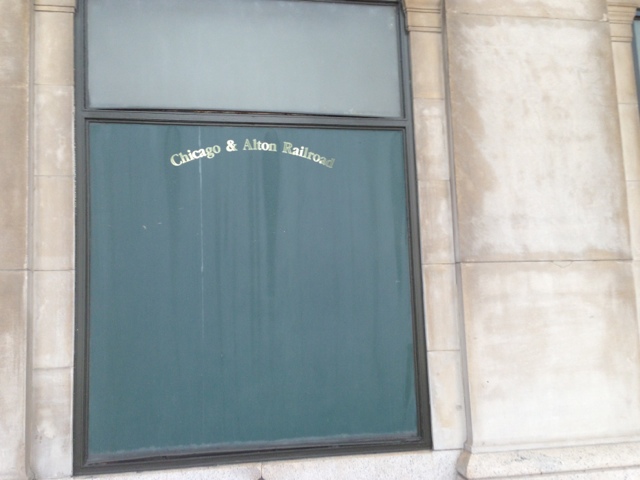
Windows on the Eastern side of Union Station list the founding railroads of Union Station in gold lettering. 


Dearborn Station also still stands but it's railway history is long gone. The building is in good shape and has a restaurant, a few small stores, and professional offices in it. Any sign that this building was once a home to such legendary trains as Santa Fe's Super Chief are long gone. 


Central Station is no longer and was demolished in 1974. However, Central Stations legacy lives on at Millenium Station which lies below Chicago's Millenium Park, beneath that "Bean" and "Pritzker Pavillion". Millenium Station still serves Illinois Centrals electric line, now part of Metra. You might have seen Millenium Station in "The Dark Knight", as Batman raced his Batbike through it. 


Northwestern Station operates as part of Metra/Union Pacific Railway. However the original station structure was demolished in 1984 and replaced with a towering office building, that has hints of the original structure still in it. Ogilvie Station as it is now called, still has the original platform and overpass from the C&NW in place. 


Picture of above street platform from original structure, taken from Clinton side, looking at Randolph overpass


The station itself though is very modern and geared toward the thousands of commuters who pass through daily with grab and go shopping and food court


Ogilvie Station


Grand Central Station on the other hand is totally gone and nothing but a vacant lot remain, sadly it was ripped down in

1969, and has no surviving lagacy. 


Lasalle Station like Ogilvie exists but has been modernized with original parts of the structure ripped down and replaced for the lucrative air rights in 1981. So don't go looking for where Cary Grant shaved in North by Northwest that part is long gone. But the station survives and is operated by Metra for its Rock Island district. 


Lasalle Street Station as it now looks


So of the six stations from the golden era only one stands as is and is functional, one stands but no longer as a station, one is totally gone, two stand in their original spots but rebuilt and modernized, and one is gone but had its place taken elsewhere. But that also means Chicago has four train stations that see thousands of passengers a day, three which operate in the same spots they did long ago. 


If you want to see living history, and the legacy of what once was Metra can accommodate you at Union, Ogilvie, LaSalle and Millenium Station, and Amtrak can too at Union Station. If your  visiting Chicago as a Route 66 follower and/or a railfan be sure to check at least one of these stations out, and if possible take a short ride on one of Metra's trains. 


Wednesday, August 7, 2013

The Super Chief & Route 66: Icons of American Transportation - 2 Rivals, 1 Shared Death

The Train of the Stars

The Santa Fe Super Chief was the epitome of luxury travel in its heyday. It was surpassed only by the "Orient Express" in lavishness and worldwide fame. It was the way to travel in the golden era, a moving 4-Star hotel and restaurant inhabited by movie stars, musicians, politicians, and other notables of that long past era of glamour and class. 

But, sadly the Super Chief was born into an era that had already foreseen the benefits of alternative forms of travel. In many ways the Super Chief was conceived much in the same way a child is to parents trying to save a marriage, as a last ditch effort to fight an inevitable end.

 In 1937 Santa Fe hoped that the first class service, glamour, and opulence of the train would attract passengers who might travel by the as of yet, fledgling and uncomfortable airlines, or across country by automobile or bus. The strategy did work, but passenger railway service continued to erode, even as Santa Fe introduced additional trains in the Super Chiefs shadow, and other railways developed luxury trains of their own. 

America's Mainstreet

One of the biggest detractors from Santa Fe passenger service was Route 66. The route which also traveled from Chicago to Los Angeles, meets up with the Santa Fe Super Chief tracks in New Mexico, and follows it very closely all the way to Los Angeles. Introduced as part of the US Route highways system in 1926. Route 66 was one of many paved cross country routes being built by the government to encourage commerce and cross country travel. 

By 1926 and in the years to come automobiles where becoming more and more advanced, and Americans had a wide variety of vehicles to choose from. Matched with paved roads automobiles of the late 20's and early 30's could travel long distances easily and at higher rates of speed covering the 2000 miles from Chicago to LA in 3 days to a week. 


Route 66 quickly became a favorite of drivers because the route left Chicago and the Midwest and headed Southwest to milder climates, through relatively flat terrain. This meant that Route 66 was for the most part, a year round East-West route. Meaning the route also attracted trucks, and buses as well. Route 66 coupled with the more modern cars of the era quickly became a competitor of the Santa Fe Railway. Automobile travel after all allowed people to travel at their own pace, stay where they want, and see things they want to. It also allowed them to do this in the comfort of there own automobiles, and considerably cheaper then train tickets. 

Another option that Route 66 gave cross country travelers was bus. In the 1930's and 1940's bus travel didn't have the negative implications it does now. Look at movies like "It Happened One Night", and the song "We Fell in Love on a Grayhound Bus", as examples of the eras view of cross country bus travel. Bus travel was significantly cheaper then train travel, and gave passengers access to more towns along the way. 


Airborne Revalution 

The future of both Route 66 and the Super Chief would soon be intertwined. By 1935 two years before the Super Chiefs development, and 9 years after US 66's development Douglas Aircraft would come out with the DC-3. The twin engine airliner wasn't the worlds first airliner, but it was the first to offer an airframe sturdy enough to fly longer, and in adverse conditions within reason, while keeping passengers comfortable. The sturdy airframe also gave that airlines more utility since the DC-3 could take on some of the more primitive runways at the time, allowing the airlines access to medium and small cities, and giving passengers more options. 

By World War II the DC-3's legacy had spread into the next generation of four engine airliners. Douglas, as well as Boeing, Convair, Lockheed, and others where all building long range transport aircraft, not only to hopefully snag lucrative government contracts, but to help claim market share with the airlines after the war ended. By the late 1940's air travel became more prevalent then ever, and the airlines of that era became synanomous with the aircraft they used, TWA had is Constellations, and United its Stratoliners, and Pan Am its DC-6's.  

But the railways lucked out breifly due to the fact that in the minds of most Americans air travel was either still unsafe  and/or meant only for overseas travel. Trains like the Super Chief also benefited from the fact that domestic airline traffic was considered to lack the glamour and comfort of rail travel. In the film "North by Northwest", there id a scene that takes place on New York Centrals luxury liner the 20th Century Limited, in which Eva Marie Saints character Eve Kendall, mentions that she discussed rail versus air travel this with Cary Grant's character Roger Thornhill when she is questioned by police about her meeting with him in the dining car. Meaning such opinions about rail and air travel permiated pop culture even into the late 50's.

Super Slab

As challenging as the 1940's would be on railroad passenger operations, and to a lesser extent Route 66, the 50's would prove to be even harder on both. Aviation and a new Federal Highway act would both deal hard blows to the legendary pair before the decade was out. 

In 1956 the Federal Aid Highway Act was passed, as part of the Eisenhower Interstate Commerce System. Eisenhower was a participant of General Pershings Army expidetion down the Lincoln Highway in 1919 and became aware of the value of paved roads in increasing military mobility. Not to mention President Eisenhower was as many returning vets where, impressed with the Autobahn system they saw in Germany and elsewhere in Europe during World War II. The large flat and straight sections of highway, without stops, and toll booths would in Eisenhowers mind as a former general, be of strategic military value in moving men and equipment accross country quickly. It also had the benefit of increasing interstate commerce with trucks, and moving people quickly and safely in buses and cars. 


The Interstates where far superior to the US highway system in place already. Route 66 was getting a reputation for being dangerous as "Bloody 66" for accidents, and for being a bottle neck through some towns. Planned interstates such as I-40 wouldn't enter towns, and being flat and four lanes would greatly reduce accidents. One of the first sections of Interstate to be constructed would be I-44 in Missouri a section of interstate built to replace Route 66 in Missouri, and later Eastern Oklahoma all the way to Oklahoma City. For Route 66 it's future was becoming clear.

For Santa Fe and the Super Chief it meant road travel would cut even deeper into passenger operations. The super slab interstates where fast and could delivery cars and trucks anywhere in the nation quickly. Trucking in the world of interstates posed a major danger to Santa Fe's frieght operations. With the government awarding mail contracts to trucking companies, railways across the country began to panic, and it would soon be time to cut losses.

Supersonic Dreams

In 1958 passenger aviation was revolutionized once again when Boeing introduced the 707. The 707 ushered in a new era of commercial aviation, that is still with us to this day. The 707 replaced prop driven and first generation jet airliners that took 8 or more hours to go from Chicago to LA, with a trip of 4 or less hours at high altitude above turbulence, and near the speed of sound. Passenger aviation was now more comfortable and quicker then it had ever been. 


The 707 was also able to sway public opinion on aviation thanks in part to pop culture embracing the "Jet Age" at that time. An era in which even cars where being made to look like jet fighters and spaceships, and Americans became obsessed with space flight, technology, and science fiction. People began to connect glamour with the "Jet Set", and train travel became outdated and slow in public opinion. 

With only two weeks of vacation a year why would a family want to spend days of it on a train when they could reach there designation in a few hours? This also applied to the concept if driving across country, why waste 3 days driving down Route 66 when you could be there in 4 hours, and rent a car at the airport? 

The 707 and its Lockheed, and Douglas clones soon to come, spelled certain doom for both Route 66 and the Super Chief. 

2 Rivals, 1 Death

The 1960's bought more jet liners and more completed interstates. The railroads realizing they had to save themselves began to cut passenger operations, and/or merge with other railways. For Santa Fe the all sleeper Super Chief, would be combined with the all coach El Capitan. The combined train would operate as the Super Chief but its glamour days where gone. Movie stars traveled first class on commercial airlines or in first generation private jets. The glitz of places like Dearborn and Union Stations had been replaced with O'Hare, and LAX. 

Initially the 60's where easy on Route 66 and bought very little change since the interstates where still under construction, but traffic slowly but surely began to decline. By the late 60's and early 70's this would change competely. I-44 would see sections completed in both Missouri and Oklahoma but the early to late 60's both detracting from, and even eating up sections of Route 66. I-40 would see construction starting in Oklahoma as early as 1959, and Texas as early as 1962. Sections completed in New Mexico by 1960, and many in Arizona by 1968, and various sections completed in California during the same time frame. In Illinois I-55 would eat up many parts of Route 66, by 1970. 

The 70's saw the death of both Route 66 and the Super Chief. The jet age and interstates had taken their final toll on the geographically intermingled pair, and passengers dried up on the Santa Fe's passenger services, and traffic dried up through Route 66 towns. 

On May 1st, 1971 Santa Fe turned the train over to Amtrak, ending the railways operation of the famous passenger train. By 1974 Santa Fe pulled the Super Chief name from Amtrak, placing the final nail in the coffin of what was once the epitome of style, glamour, and class known as The Super Chief, and ending an era. It would be 1984 before a Chief or Amtraks Southwest Chief would ride the rails again, having been known as the Southwest Limited between 1974 and 84. But the Super Chief and all of Santa Fe's famous passenger trains where now gone. 

In the late 70's Santa Fe and many other railroads would struggle to survive and make thier freight operations competitive against interstate trucking. Santa Fe would survive and blossom with a "if you can't beat them, join them" philosophy. The railway would introduce a train known as the Super C, an all TOFC or Trailer on Flatcar train that rain between Chicago and LA. This train would be the first of the intermodal transports that would become highly lucrative in years to come. 

But as 1984 saw the mere spark of the Chief's return the rails under Amtrak, it also saw the final end to Route 66. The last sections of the old Route would be decommissioned near Williams, Arizona. Decertifing Route 66 as a US Highway. In effect Route 66's death certificate had been signed. 

1984 was a year of finality for US Route 66 and the Santa Fe Super Chief. Even though both would leave legacy's that to this day are remembered, commemorated, and loved that year would be that final goodbye for both.