Showing posts with label LA. Show all posts

Friday, January 24, 2014

Experiencing the Dining Car as It Use To Be

Train travel in the United States today is a far cry from what it once was. Only the long distance passenger trains have dining cars, and although the food is good and passengers are presented with a menu to choose from breakfast, lunch, and dinner much of the food comes semi-prepared. Dining on Amtrak is still a treat, and well worth experiencing both for its coolness factor and historical connection. Dining by rail though was once something completely different from what it is now. 

Back before the disintegration of the great passenger trains, dining by rail was something that helped distinguish one railway from another. Some railways even became famous for particular items on their dining car menus. Food on the dining car wasn't just sustenance to eat while the train sped along for many miles but instead it had become a gourmet dining experience that was on par with some of the larger cities finest gourmet eating establishments.

It wasn't always this way though dining cars really didn't come into fully functional service until around the time of World War I. Before then various food service  cars had been experimented with, railways tried everything from lunch cars to buffet cars to cafĂ© cars, all of which came with varying results. Most of these experiments started back around the time of the transcontinental railway and lasted all the way through the late 19th century into the very early 20th century. For the most part though if passengers wanted to eat along the way in this time period it required passengers to deboard trains at towns where the locomotive was forced to stop to take on coal and water. One can only imagine the inconvenience of having to do such a thing especially with having to worry about weather or the possibility of missing ones train and/or meal. 

It was during this same period time that the Santa Fe Railway entered into an agreement with the Fred Harvey Company. The Fred Harvey Company would provide eating establishments at larger whistle stops for the Santa Fe and the Santa Fe would agree to extend the time it took take on coal and water for their trains so that customers could have a leisurely meal at one of Harvey's restaurants. These restaurants became known as Harvey Houses, and I will take a deeper look at some Harvey Houses in postings to come. But Harvey Houses did something else they gave passengers a quality meal that was stress-free since Harvey Houses were located close to the Santa Fe tracks, the food was prepared in conjunction with trains that where stopped over, and managers would often wonder the Harvey House dining rooms notifying passengers of departing trains.

As a decades wore on locomotive's became more technically advanced which required them to stop less for coal and water. Eventually locomotives only had to make longer stops at larger cities meaning many of the whistle stops where they had previously allowed passengers to the leave the train in order get a meal where now totally bypassed as the train passed through them at high speed. For the railways it was time to finally have onboard dining facilities. By the 1910's advancements in onboard cooking, and refrigeration finally gave the railways the chance to produce effective dining cars. By the 1930s dining cars were at their peak, and so to was each railways need to brag that it had the best food. To say the least the battle between the railways for the best dining car would carry-on for 30 more years finally culminating in the 1960s with the Santa Fe Super Chiefs Turquoise Room, a special five-star dining room located in the Super Chiefs dining car and known for attracting the glitz and glamour of movie stars and other famous people of the era. 

By the 1970s the railways, specifically the passenger lines would go into to decline and many of them would disappear from memory. However memories of the wonderful food on their dining cars still remain and some have dedicated themselves to maintaining the memory of this food.


The books above James D Porterfield's Dining By Rail, and George H Foster and Peter C Weiglen's The Harvey House Cookbook are two great books commemorating the railway dining experience.

Dining By Rail functions as both a great history book and cookbook. Porterfield gets in-depth with the evolution of dining cars on various railways and then also manages to get in depth with how the various railways came about designing some other most famous menu options. Porterfield carefully brings together some brief histories and recipes from over 40 different railways. One of my favorite parts of this book is when Porterfield mentions the great French Toast Battle in which the Northern Pacific, Soo Line, Union Pacific, Santa Fe, and Pennsylvania railways try to compete for the best French Toast recipe, and you can find the French Toast recipe for each of these railways right here in this book.  There are hundreds of other excellent recipes from the railway dining cars listed in this book as well as a lot of great insight into life in the dining car. It's well worth the read in these recipes are definitely worth trying at home if you want to get a taste of how high-quality the food was I many of these dining cars.

The Harvey House Cookbook is another fantastic book to add to the overall experience of dining by rail. The book is dedicated to Harvey Houses, but is intermixed with recipes from various Santa Fe passenger trains. This is another fantastic book for gaining both historical insight into the operations of Harvey Houses and Santa Fe passenger trains and for just getting overall taste of what it must been like to actually have eaten at these places during their heyday. The book covers some of Fred Harvey's most notable resorts like the La Posada in Winslow, AZ, and the La Fonda in Santa Fe, NM, as well as some of it's other operations like Los Angeles, and Chicago Union Stations, and Chicago's Midway Airport. This book has a fantastic layout in which the historical text is in between the recipe sections which are themselves laid out by meal segments. All though this book isn't as in depth with Harvey House history as some other books it is a fantastic and should I say hands on or taste buds on introduction to Harvey House's which is extremely unique for any book on this subject. The book also allows us to see how dining cars where developed by giving us a peek into the period in which rail travel dining transferred from Harvey Houses to actual dining cars since some recipes in this book come from the California Limited, Santa Fe's precursor to the Chief and Super Chief, and the first of their trains to present onboard dining in a first class manor.

I must own 2 dozen books on the Santa Fe, but of all of them these two are the only ones that give me a real feel for what it must have been like to have been there, and put this piece of history in such human terms through a connection to food.


Wednesday, August 14, 2013

Not much "Union" at Union Station

Heading East or West down Route 66 through Chicago it's impossible to miss Union Station. The crowds of people crossing the street near the river is usually the tip off. 


For most cities including LA, the "Union" in Union Station indicates that the station serves as the unified train station for the city meaning all trains no matter what the railway come to that station. But in Chicago that's not the case, now or in the past.  


Now days Union Station is the central station for all cross country trains, but not all passenger trains in Chicago come here. Metra, Chicago's massive commuter train service has trains that come to Union Station, but also trains that go to other stations following the heritage of the original railways that are now part of the Metra system.  Of course it has long been noted that when it comes to Union Station the relationship between Metra and Amtrak is at times strained, especially since Amtrak controls the  station dispite Metra having more trains operate out of the station every single day. 


Metra is an interesting case and point about the original stations and rail lines that came into the city of Chicago in the past, since Metra still operates at a lot of those stations either in the original form or more modern reincarnations. Or to put it another way if you want to experience the terminals and sites of historic American passenger trains Metra may provide you with a living examples, something your not likely to see anywhere else. 


Historically and in a very real modern sense Chicago is and has been the railroad hub of the United States for well over a hundred years. This means that there are hundreds of rail lines coming into the city from all directions. For the great Eastern railways that there where and are, Chicago was a the Western Terminus, for the Western Railways the Eastern terminus, and the same could be said for the Northern railways of Canada with a Southern end, and Southern with a Northern end. One can only imagine that with trains coming in on multiple tracks from all directions, the concept of a central station would cause severe rail gridlock as trains converged on one point. So Chicago would need to accomdate passenger trains with more then one station. 


For most railroads this wasn't to their dislike. A railroad station built for their specific needs, could show off the railways affluence, and market the railway to its captive audience of passengers. Ornate woodwork, gold leaf fixtures, marble floors and columns, and a plethora of top quality restaurants and passenger service stores allowed railways to instill a feeling of luxury, and service to passengers, and others passing through the stations. 


Union Station Chicago is an excellent example of railway architecture and interior design for stations during the golden era of train travel.


In the height of the rail travel era Chicago was served by 6 major train stations:


-Union Station that served the Chicago, Burlinton, and Quincy, Milwaukee Road, and Pennsylvania Railways, and several smaller lines. 


Union Station today, in the right of the picture above the "bacon" truck you can see part of the office building stucture that replaced the terminal building. 


-Northwestern Station which served the Chicago Northwestern, B&O, Union Pacific, and smaller lines. 

-Lasalle Street Station that served the New York Central and played a major part in Hitchcocks North by Northwest. Lasalle Street also served the Rock Island. 

-Central Station which served the Illinois Central, C&O, and smaller lines 

-Dearborn Station which famously served the Santa Fe, as well as the Grand Trunk,  Erie, Monon, and Wabash.

-Grand Central Station which also served that B&O, SOO, and smaller lines. 


Of the six stations only Union Station remains in its original form both in structure and operation. Or I should mention that its Grand Hall still stands which is the true show piece of the station. The terminal structure that stood accross Canal Street from it was replaced with an office complex in the 1960's. 


Old postcard depicts the entire Union Station complex as it was. Only the larger building in back the "Grand Hall" still stands, but it is a functional structure that accommodates thousands of passengers daily. 


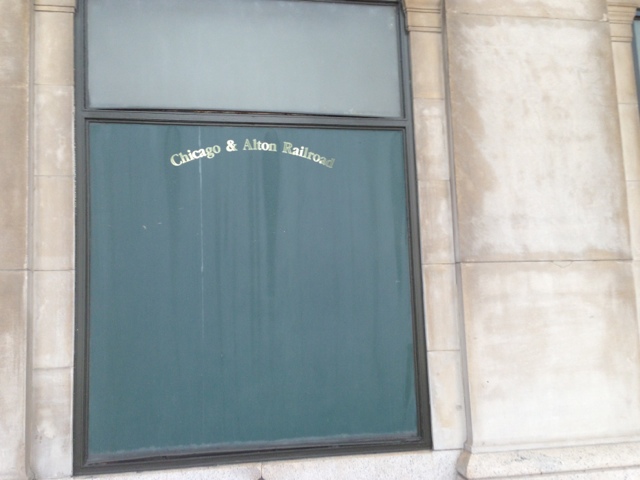
Windows on the Eastern side of Union Station list the founding railroads of Union Station in gold lettering. 


Dearborn Station also still stands but it's railway history is long gone. The building is in good shape and has a restaurant, a few small stores, and professional offices in it. Any sign that this building was once a home to such legendary trains as Santa Fe's Super Chief are long gone. 


Central Station is no longer and was demolished in 1974. However, Central Stations legacy lives on at Millenium Station which lies below Chicago's Millenium Park, beneath that "Bean" and "Pritzker Pavillion". Millenium Station still serves Illinois Centrals electric line, now part of Metra. You might have seen Millenium Station in "The Dark Knight", as Batman raced his Batbike through it. 


Northwestern Station operates as part of Metra/Union Pacific Railway. However the original station structure was demolished in 1984 and replaced with a towering office building, that has hints of the original structure still in it. Ogilvie Station as it is now called, still has the original platform and overpass from the C&NW in place. 


Picture of above street platform from original structure, taken from Clinton side, looking at Randolph overpass


The station itself though is very modern and geared toward the thousands of commuters who pass through daily with grab and go shopping and food court


Ogilvie Station


Grand Central Station on the other hand is totally gone and nothing but a vacant lot remain, sadly it was ripped down in

1969, and has no surviving lagacy. 


Lasalle Station like Ogilvie exists but has been modernized with original parts of the structure ripped down and replaced for the lucrative air rights in 1981. So don't go looking for where Cary Grant shaved in North by Northwest that part is long gone. But the station survives and is operated by Metra for its Rock Island district. 


Lasalle Street Station as it now looks


So of the six stations from the golden era only one stands as is and is functional, one stands but no longer as a station, one is totally gone, two stand in their original spots but rebuilt and modernized, and one is gone but had its place taken elsewhere. But that also means Chicago has four train stations that see thousands of passengers a day, three which operate in the same spots they did long ago. 


If you want to see living history, and the legacy of what once was Metra can accommodate you at Union, Ogilvie, LaSalle and Millenium Station, and Amtrak can too at Union Station. If your  visiting Chicago as a Route 66 follower and/or a railfan be sure to check at least one of these stations out, and if possible take a short ride on one of Metra's trains. 


Winslow, Arizona - Transportation Hub of the Western U.S.?

When you hear Winslow, Arizona it is very hard to not hear the song "Take it Easy" by the Eagles running through your head. If your anything like me you imagine them referring to some tiny desert town, with a few houses and stores, and tumbleweed blowing down the street. When you actually see Winslow though you find it's a lot different then you had expected. 


Winslow has the honor of not only being a Route 66 town, but also the district headquarters of the Santa Fe, now BNSF. This meant that Winslow was not only visited by Route 66 travelers, but had such iconic Santa Fe trains as The Super Chief, and El Capitan pass through daily. One could only imagine that in the 1940's through early 60's between Route 66 and the daily precession of Santa Fe passenger trains, Winslow was a busseling travel mecca. 


But did you know Winslow also has passenger aviation history as well? This fact was bought to public intetest thanks to a traveling exhibit that the Smithsonian, in conjunction with the Winslow Old Trails Museum, and La Posada Hotel, bought to Winslow last week as part of its "Journey Stories" tour. One of the exhibits and lectures made the world  aware of this forgotten part of Winslow's and avaitions history. The TAT or Transcontinental Air Transport airline came to being in 1928, flying its first flights in 1929 offering a hybrid of air and rail transport to deliver passengers from New York to LA or San Francisco in 48 hours. 


Winslow was a fueling stop on the second air leg of the westbound trip. But by no means was Winslow nothing more then a runway and a fuel tank. The airport itself was state of the art at the time designed by Charles Lindbergh, giving the airport part of its name Winslow-Lindbergh. 


Sadly, the TAT was short lived and after an accident a few months after the first flights TAT was forced to emerge with other airlines that would eventually became TWA. By the mid-1930's non-stop passenger travel also became more prevalent, especially with the development of the sturdy DC-3 by Douglas in the late 1930's. This meant that Winslow not being a major city was bypassed by most major airlines, however the airport lived on serving the military in World War 2 as a USAAF Transport base. The airport still serves general aviation, US Forest Service fire planes, and occasionally some military. 


It's interesting to note that between Route 66, Santa Fe's operations, and the potential of the TAT Winslow was in fact a Western travel hub in 1929. I would have to suggest definitely spending time in Winslow if you can, make sure to stop by and see the Old Trails Museum, and the La Posada which is worth staying and/or eating at. I would have to suggest seeing both since you can learn all about Winslows place in transportation history from both places,since they work hand and hand with each other to present a complete picture. If you in to train watching or your kids are, Winslow has a lot to offer as well. 


 TAT Ford Tri-motor flown by Charles Lindbergh. 


I'll cover the TAT more in future blog postings

Friday, August 9, 2013

Boron a Town of Ghosts & Legacy's: Part 1 - Legacy of The Chief

A small Mojave Desert town witnesses the legacy of American transportation history. 


40 miles West of Barstow is the town of Boron, CA. In late summer through early fall the nights are beautiful. The temps stay in about the mid-70's, the gentle desert breeze creates music in the windchimes, and there are no Mosquitos for several hundred miles. The nights are perfect for sitting outside and having a great conversation over a few glasses of wine, or just gazing at the stars. 

The only thing that interupts these quiet nights are the sounds of BNSF frieght trains pushing through town a few times an hour. After a while even that becomes part of that ambient environment, and the rumble of trains seem natural and missed  after they pass. 

From the porch of my wife's childhood home, one can look accross a 1/2 mile of desert and see the trains pass. Sometimes as you sit there, especially at night, your imagination allows you to hear what these tracks where 60 plus years before as steam locomotives made their way down these stretches. You can hear the whistles blow, and the chuffs of steam, and see the glow of the fireboxes in the still desert night. You can imagine the outline of a 2-10-4 Texas, pulling an endless stream of box cars in your minds eye. 

You see as middle of nowhere and as far from civilization and history this little desert town may seem, the town itself has many stories to tell. This little nowhere town has a history that in many ways should make it well known, yet it lies forgotten. You see in Boron, the roads, the tracks, and the sky all have a story to tell. Boron is a town of ghosts and legacy's in 20th century American history. 

The tracks running through Boron have a particularly captivating history. Currently these tracks serve a very busy BNSF route between the Barstow Yards and the Bay Area, as well as serving a lively spur to US Borax mining operations nearby. But the interesting facts about these tracks is that until 1971 these tracks saw Santa Fe passenger operations. 

Such trains as the San Francisco Chief, The Navajo, and The Grand Canyon all traveled this route on their way North through the Tehachapis and on to the San Francisco Bay Area. I can only imagine what it must have been like to pass through the tunnels and grades of thr Tehachapi mountains, and than the famous Tehachapi Loop as a passenger on one of these trains. 


Although the bulk of Santa Fe's passenger trains headed to Los Angeles, Santa Fe knew that the San Francisco market was competitive, and lucrative. Passenger service to San Francisco gave Santa Fe access to the surrounding cities of the Bay Area and Northern California beyond. The San Francisco Chief was Santa Fe's luxury answer to the City of San Francisco a luxury liner jointly opetated by the Union Pacific, Chicago Northwestern  and Southern Pacific, and the jointly operated California Zypher shared between the CB&Q, Western Pacific, and D&RG. Santa Fe was obviously hoping the brand value of The Super Chief would carry over to the name on the San Francisco Chief when the luanched the service in 1954, which obviously it did since the train discontinued service in 1971 with all other Santa Fe passenger operations.

The Navajo was meant to serve a similar role as the El Capitan did on the Los Angeles route as an all coach consist, and The Grand Canyon was to serve a mixed consist aimed at Grand Canyon tourism and the Santa Fe/Fred Harvey operations nearby. 


As in the cases of most passenger trains the town of Boron probably saw each of these trains twice a day, one Eastbound, the other Westbound. I try to imagine what it must have been like for this small town to see the Warbonnet livery, and gleaming consist of silver stainless steel passenger cars flying through the town. You have to ask what stories could be told, and if and when the trains made flag-stops to pick up town residents. 


I could only imagine what a thrill it would have been to stand on the porch of my wife's childhood home, or from the patio of Domingo's Restaurant in town and see these trains go by. To see the desert sun shining off the cars and thier windows, and watching the train disappear accross the flat desert beyond. 

To its residents of Boron the mere fact that these silver luxury liners passed through town every day must have made them feel like the center of the world at that time. Today though there are no reminders of that era, no connection to those gleaming daily visitors. What are left behind are the ghosts of Santa Fe's passenger train heydays, and the legacy of its operations in today's BNSF traffic through the town. 

But remember I said the roads and sky had a story to tell here too, and I will tell them in postings to come. 


Wednesday, August 7, 2013

The Super Chief & Route 66: Icons of American Transportation - 2 Rivals, 1 Shared Death

The Train of the Stars

The Santa Fe Super Chief was the epitome of luxury travel in its heyday. It was surpassed only by the "Orient Express" in lavishness and worldwide fame. It was the way to travel in the golden era, a moving 4-Star hotel and restaurant inhabited by movie stars, musicians, politicians, and other notables of that long past era of glamour and class. 

But, sadly the Super Chief was born into an era that had already foreseen the benefits of alternative forms of travel. In many ways the Super Chief was conceived much in the same way a child is to parents trying to save a marriage, as a last ditch effort to fight an inevitable end.

 In 1937 Santa Fe hoped that the first class service, glamour, and opulence of the train would attract passengers who might travel by the as of yet, fledgling and uncomfortable airlines, or across country by automobile or bus. The strategy did work, but passenger railway service continued to erode, even as Santa Fe introduced additional trains in the Super Chiefs shadow, and other railways developed luxury trains of their own. 

America's Mainstreet

One of the biggest detractors from Santa Fe passenger service was Route 66. The route which also traveled from Chicago to Los Angeles, meets up with the Santa Fe Super Chief tracks in New Mexico, and follows it very closely all the way to Los Angeles. Introduced as part of the US Route highways system in 1926. Route 66 was one of many paved cross country routes being built by the government to encourage commerce and cross country travel. 

By 1926 and in the years to come automobiles where becoming more and more advanced, and Americans had a wide variety of vehicles to choose from. Matched with paved roads automobiles of the late 20's and early 30's could travel long distances easily and at higher rates of speed covering the 2000 miles from Chicago to LA in 3 days to a week. 


Route 66 quickly became a favorite of drivers because the route left Chicago and the Midwest and headed Southwest to milder climates, through relatively flat terrain. This meant that Route 66 was for the most part, a year round East-West route. Meaning the route also attracted trucks, and buses as well. Route 66 coupled with the more modern cars of the era quickly became a competitor of the Santa Fe Railway. Automobile travel after all allowed people to travel at their own pace, stay where they want, and see things they want to. It also allowed them to do this in the comfort of there own automobiles, and considerably cheaper then train tickets. 

Another option that Route 66 gave cross country travelers was bus. In the 1930's and 1940's bus travel didn't have the negative implications it does now. Look at movies like "It Happened One Night", and the song "We Fell in Love on a Grayhound Bus", as examples of the eras view of cross country bus travel. Bus travel was significantly cheaper then train travel, and gave passengers access to more towns along the way. 


Airborne Revalution 

The future of both Route 66 and the Super Chief would soon be intertwined. By 1935 two years before the Super Chiefs development, and 9 years after US 66's development Douglas Aircraft would come out with the DC-3. The twin engine airliner wasn't the worlds first airliner, but it was the first to offer an airframe sturdy enough to fly longer, and in adverse conditions within reason, while keeping passengers comfortable. The sturdy airframe also gave that airlines more utility since the DC-3 could take on some of the more primitive runways at the time, allowing the airlines access to medium and small cities, and giving passengers more options. 

By World War II the DC-3's legacy had spread into the next generation of four engine airliners. Douglas, as well as Boeing, Convair, Lockheed, and others where all building long range transport aircraft, not only to hopefully snag lucrative government contracts, but to help claim market share with the airlines after the war ended. By the late 1940's air travel became more prevalent then ever, and the airlines of that era became synanomous with the aircraft they used, TWA had is Constellations, and United its Stratoliners, and Pan Am its DC-6's.  

But the railways lucked out breifly due to the fact that in the minds of most Americans air travel was either still unsafe  and/or meant only for overseas travel. Trains like the Super Chief also benefited from the fact that domestic airline traffic was considered to lack the glamour and comfort of rail travel. In the film "North by Northwest", there id a scene that takes place on New York Centrals luxury liner the 20th Century Limited, in which Eva Marie Saints character Eve Kendall, mentions that she discussed rail versus air travel this with Cary Grant's character Roger Thornhill when she is questioned by police about her meeting with him in the dining car. Meaning such opinions about rail and air travel permiated pop culture even into the late 50's.

Super Slab

As challenging as the 1940's would be on railroad passenger operations, and to a lesser extent Route 66, the 50's would prove to be even harder on both. Aviation and a new Federal Highway act would both deal hard blows to the legendary pair before the decade was out. 

In 1956 the Federal Aid Highway Act was passed, as part of the Eisenhower Interstate Commerce System. Eisenhower was a participant of General Pershings Army expidetion down the Lincoln Highway in 1919 and became aware of the value of paved roads in increasing military mobility. Not to mention President Eisenhower was as many returning vets where, impressed with the Autobahn system they saw in Germany and elsewhere in Europe during World War II. The large flat and straight sections of highway, without stops, and toll booths would in Eisenhowers mind as a former general, be of strategic military value in moving men and equipment accross country quickly. It also had the benefit of increasing interstate commerce with trucks, and moving people quickly and safely in buses and cars. 


The Interstates where far superior to the US highway system in place already. Route 66 was getting a reputation for being dangerous as "Bloody 66" for accidents, and for being a bottle neck through some towns. Planned interstates such as I-40 wouldn't enter towns, and being flat and four lanes would greatly reduce accidents. One of the first sections of Interstate to be constructed would be I-44 in Missouri a section of interstate built to replace Route 66 in Missouri, and later Eastern Oklahoma all the way to Oklahoma City. For Route 66 it's future was becoming clear.

For Santa Fe and the Super Chief it meant road travel would cut even deeper into passenger operations. The super slab interstates where fast and could delivery cars and trucks anywhere in the nation quickly. Trucking in the world of interstates posed a major danger to Santa Fe's frieght operations. With the government awarding mail contracts to trucking companies, railways across the country began to panic, and it would soon be time to cut losses.

Supersonic Dreams

In 1958 passenger aviation was revolutionized once again when Boeing introduced the 707. The 707 ushered in a new era of commercial aviation, that is still with us to this day. The 707 replaced prop driven and first generation jet airliners that took 8 or more hours to go from Chicago to LA, with a trip of 4 or less hours at high altitude above turbulence, and near the speed of sound. Passenger aviation was now more comfortable and quicker then it had ever been. 


The 707 was also able to sway public opinion on aviation thanks in part to pop culture embracing the "Jet Age" at that time. An era in which even cars where being made to look like jet fighters and spaceships, and Americans became obsessed with space flight, technology, and science fiction. People began to connect glamour with the "Jet Set", and train travel became outdated and slow in public opinion. 

With only two weeks of vacation a year why would a family want to spend days of it on a train when they could reach there designation in a few hours? This also applied to the concept if driving across country, why waste 3 days driving down Route 66 when you could be there in 4 hours, and rent a car at the airport? 

The 707 and its Lockheed, and Douglas clones soon to come, spelled certain doom for both Route 66 and the Super Chief. 

2 Rivals, 1 Death

The 1960's bought more jet liners and more completed interstates. The railroads realizing they had to save themselves began to cut passenger operations, and/or merge with other railways. For Santa Fe the all sleeper Super Chief, would be combined with the all coach El Capitan. The combined train would operate as the Super Chief but its glamour days where gone. Movie stars traveled first class on commercial airlines or in first generation private jets. The glitz of places like Dearborn and Union Stations had been replaced with O'Hare, and LAX. 

Initially the 60's where easy on Route 66 and bought very little change since the interstates where still under construction, but traffic slowly but surely began to decline. By the late 60's and early 70's this would change competely. I-44 would see sections completed in both Missouri and Oklahoma but the early to late 60's both detracting from, and even eating up sections of Route 66. I-40 would see construction starting in Oklahoma as early as 1959, and Texas as early as 1962. Sections completed in New Mexico by 1960, and many in Arizona by 1968, and various sections completed in California during the same time frame. In Illinois I-55 would eat up many parts of Route 66, by 1970. 

The 70's saw the death of both Route 66 and the Super Chief. The jet age and interstates had taken their final toll on the geographically intermingled pair, and passengers dried up on the Santa Fe's passenger services, and traffic dried up through Route 66 towns. 

On May 1st, 1971 Santa Fe turned the train over to Amtrak, ending the railways operation of the famous passenger train. By 1974 Santa Fe pulled the Super Chief name from Amtrak, placing the final nail in the coffin of what was once the epitome of style, glamour, and class known as The Super Chief, and ending an era. It would be 1984 before a Chief or Amtraks Southwest Chief would ride the rails again, having been known as the Southwest Limited between 1974 and 84. But the Super Chief and all of Santa Fe's famous passenger trains where now gone. 

In the late 70's Santa Fe and many other railroads would struggle to survive and make thier freight operations competitive against interstate trucking. Santa Fe would survive and blossom with a "if you can't beat them, join them" philosophy. The railway would introduce a train known as the Super C, an all TOFC or Trailer on Flatcar train that rain between Chicago and LA. This train would be the first of the intermodal transports that would become highly lucrative in years to come. 

But as 1984 saw the mere spark of the Chief's return the rails under Amtrak, it also saw the final end to Route 66. The last sections of the old Route would be decommissioned near Williams, Arizona. Decertifing Route 66 as a US Highway. In effect Route 66's death certificate had been signed. 

1984 was a year of finality for US Route 66 and the Santa Fe Super Chief. Even though both would leave legacy's that to this day are remembered, commemorated, and loved that year would be that final goodbye for both.